IT Risk & Technology Governance in Financial Institutions
Contact us

IT Risk & Technology Governance in Financial Institutions

Language: ENGLISH

Instructors: Dr Rakesh Agarwal

Validity Period: 120 days

$250 28% OFF

$180

PREVIEW
7 Modules
46 Video Lectures
40+ Real Case Studies
20 Toolkits & Resources
25–30 Learning Hours
2 Certifications
Why this course

Technology risk is now enterprise risk

Outages, failed migrations, vendor collapses and AI failures now reach Boards and regulators. This programme shows how technology is governed across strategy, operations, controls, resilience, outsourcing, compliance and assurance, in line with RBI expectations.

🏛️

Governance & Board Oversight

Responsibilities of the Board, ITSC, CIO, CTO, CISO, Risk, Compliance and Internal Audit, and how they fit together.

📜

RBI Regulatory Expectations

IT Governance, Risk, Controls & Assurance Directions and the Master Direction on IT Outsourcing, applied in practice.

📊

Risk Assessment & Reporting

Risk registers, 5×5 scoring, appetite, KRIs and RAG dashboards that support decisions at Board level.

🛡️

Operational Resilience

Incident and change management, BIA, BCP/DR, RTO/RPO, failover testing and recovery assurance.

🤝

Outsourcing & Third Parties

Materiality, due diligence, concentration and fourth-party risk, contracts, SLAs and exit planning.

☁️

Cloud, Digital & AI

Cloud governance, API ecosystems, AI ownership, data and model risk, lifecycle validation and third-party AI.

Certification & Assessment

Earn a dual certification recognised across BFSI

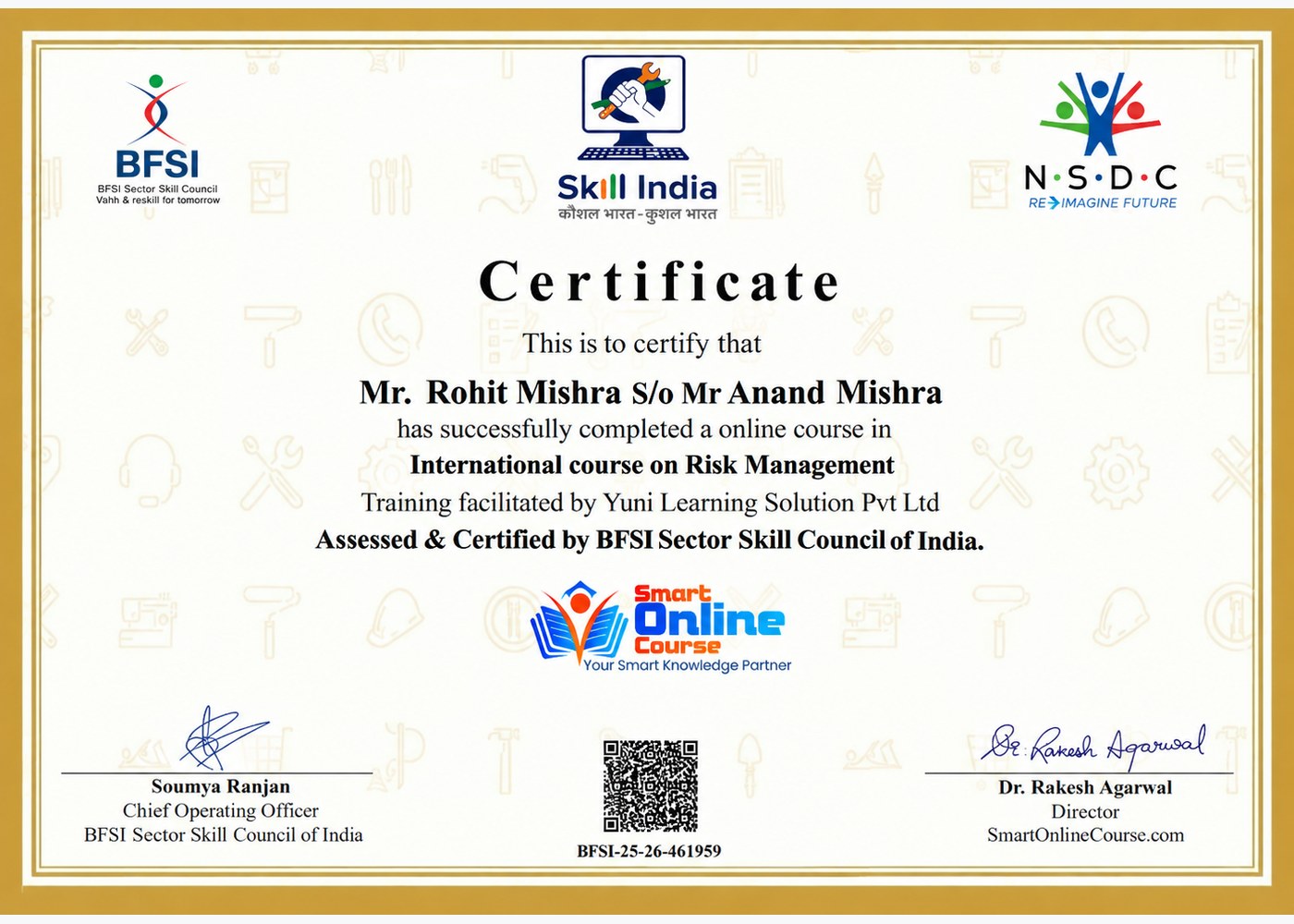
Complete the course and the BFSI SSC assessment to receive two certificates: one from Smart Online Course and the Risk Management Association of India, and one issued by the BFSI Sector Skill Council of India.
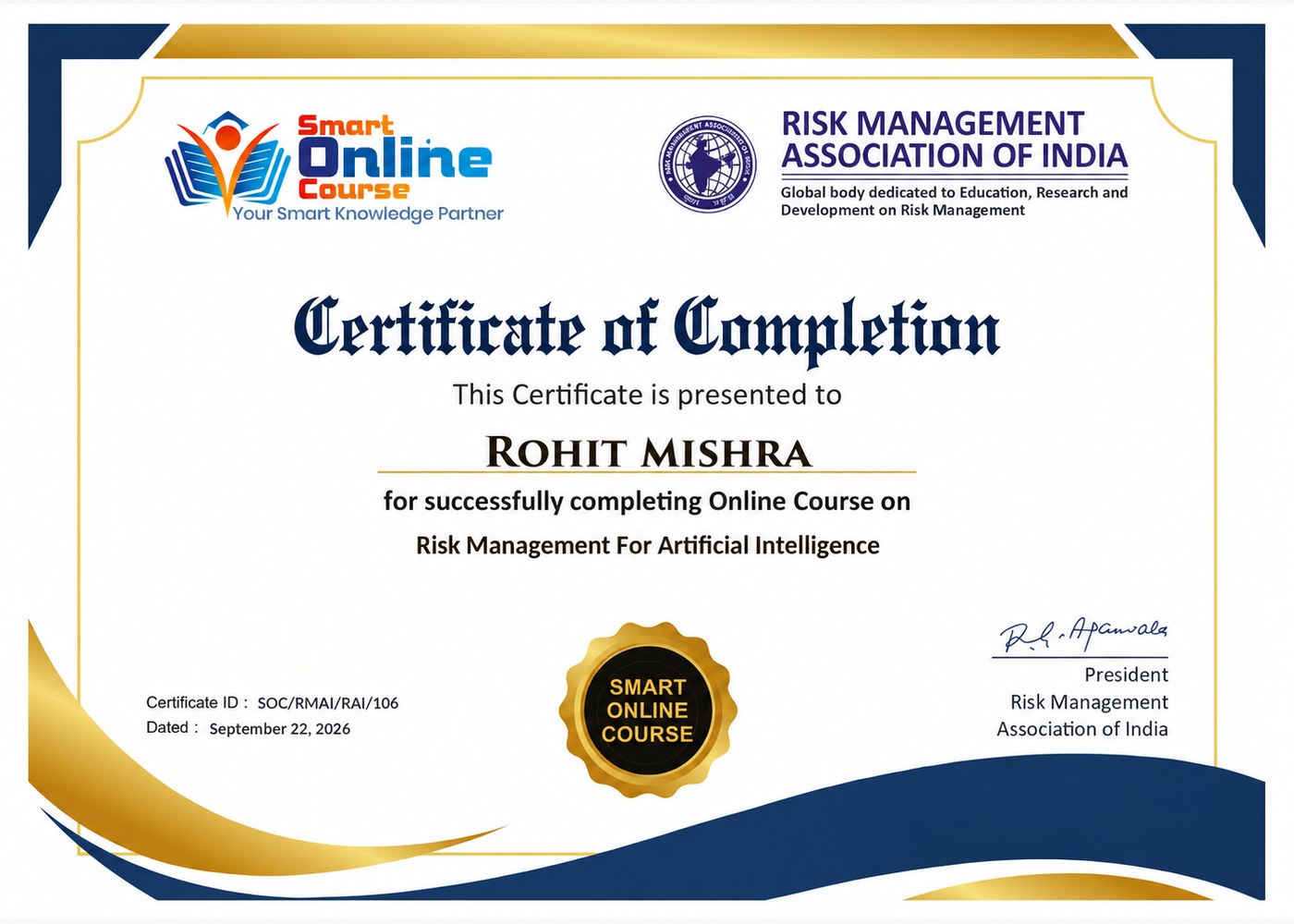
Sample Certificate of Completion from Smart Online Course and the Risk Management Association of India
Certificate 01 · RMAI + Smart Online CourseCertificate of Completion, signed by the President, RMAI
Sample certificate issued by the BFSI Sector Skill Council of India with Skill India and NSDC
Certificate 02 · BFSI Sector Skill Council of IndiaIssued by BFSI SSC, an initiative of NSDC under Skill India
Certificate 01

Risk Management Association of India (RMAI)

Certification from RMAI, the professional association behind Smart Online Course.

Certificate 02

BFSI Sector Skill Council of India (BFSI SSC)

Sector certification from the BFSI Sector Skill Council of India.

Assessment

Conducted by BFSI SSC

The final assessment is conducted by the BFSI Sector Skill Council of India.

Sample certificates shown. Dual certification is subject to successful completion and applicable assessment requirements.

Skill gaps addressed

What you'll be able to do

  • Understand IT governance beyond cybersecurity, including Board and senior-management responsibilities
  • Apply RBI expectations on IT governance, risk, controls and assurance
  • Identify, assess and prioritise technology risks using inherent and residual risk methods
  • Build technology risk appetite statements, risk registers, KRIs and management reports
  • Govern information assets, critical technology dependencies and change-management risk
  • Evaluate IT operations, business continuity, disaster recovery and resilience testing
  • Manage outsourcing: vendor due diligence, concentration, sub-outsourcing and exit planning
  • Understand IT General Controls, application controls and technology assurance
  • Connect IT, Information Security, Risk, Compliance and Internal Audit
  • Assess cloud, API, digital-platform and AI model risks from a governance perspective
Who should enrol

Built for technology, risk and assurance professionals in BFSI

For IT, risk, compliance and audit teams in banks, NBFCs, insurance companies and financial institutions, and for senior and middle managers who make or oversee technology decisions.

  • IT & technology professionals in banks, NBFCs and insurers
  • IT Risk, Operational Risk and Compliance teams
  • Internal Audit and IT Audit professionals
  • CIO / CTO office and steering committee members
  • Vendor management, digital banking and FinTech professionals

Relevant job roles

CIO CTO CISO IT Risk Manager Technology Risk Professional IT Governance Professional IT Compliance Professional Operational Risk Professional ERM Professional Internal Auditor IT Audit Specialist Cybersecurity Governance Vendor Risk Manager Third-Party Risk Analyst Technology Project Manager Digital Transformation Technology Operations Manager Information Security Executive
Curriculum

7 modules · 46 lectures · a real case study in every lecture

Each 15-minute lecture pairs the concepts with a practical example and a documented industry case, followed by an MCQ knowledge check.

01IT Risk & Technology Governance FundamentalsTechnology as an enterprise risk, and who owns it4 lectures
1 hour
⌄
1.1

Technology Dependency in Financial Institutions

Case: RBS, NatWest & Ulster Bank IT Failure, 2012
1.2

Understanding IT Risk & Its Relationship with Other Risks

Case: Knight Capital Technology Failure, 2012
1.3

Fundamentals of IT Governance & Strategic Alignment

Case: TSB Bank IT Migration Failure, 2018
1.4

Technology Risk Ownership, Roles & Accountability

Case: DBS Digital Banking Disruptions, 2023
02IT Governance Framework, Strategy & Regulatory ExpectationsBoard oversight, RBI directions, project governance and IT policies6 lectures
1.5 hours
⌄
2.1

IT Governance Framework & Board Oversight

Case: RBI IT Governance, Risk, Controls & Assurance Practices Directions, 2023
2.2

Management Committees, Technology Leadership & Accountability

Case: HDFC Bank Digital Outages & RBI Restrictions, 2020
2.3

RBI IT Governance, Risk, Controls & Assurance Expectations

Case: RBI Supervisory Action against Kotak Mahindra Bank, 2024
2.4

IT Strategy, Technology Investment & Portfolio Governance

Case: Citibank OCC Enforcement Action, 2020
2.5

Technology Project, Development & Implementation Governance

Case: NASDAQ Facebook IPO Technology Failure, 2012
2.6

IT Governance Policies, Documentation & Technology Competency

Case: Mizuho Bank System Failures, 2021
03IT Risk Assessment, Information Assets, Controls & Risk ReportingIdentify, assess, treat, control, monitor and report technology risk8 lectures
2 hours
⌄
3.1

Technology Risk Identification & Risk Universe

Case: MUFG Union Bank Technology Risk Governance Deficiencies, 2021
3.2

Information Asset Identification, Classification & Criticality

Case: Morgan Stanley Smith Barney Data & Hardware Disposal Failures, 2022
3.3

IT Risk Assessment Methodology

Case: Capital One Public Cloud Risk Assessment Failures, 2020
3.4

IT Risk Treatment, Risk Register & Risk Ownership

Case: Evolve Bank & Trust Enforcement Action, 2024
3.5

Technology Risk Appetite, Tolerance & Escalation Thresholds

Case: Commonwealth Bank of Australia Prudential Inquiry, 2018
3.6

IT Control Framework & Key Technology Controls

Case: Bank of Bahrain & Kuwait RBI Penalty, 2022
3.7

Technology KRIs, Monitoring & Risk Dashboards

Industry example: Axis Bank Operational Risk Reporting Framework
3.8

Technology Risk Reporting, Escalation & Management Action

Case: Bank of Ireland IT Service Continuity Control Failures, 2021
04IT Operations, Change Management, Resilience & Business ContinuityIncidents, change, BIA, BCP/DR, RTO/RPO and resilience testing6 lectures
1.5 hours
⌄
4.1

IT Operations, Service Availability & Performance Management

Case: Visa Europe Service Disruption, 2018
4.2

IT Incident & Problem Management

Case: Federal Reserve Payment Systems Outage, 2021
4.3

Change, Release & Production Implementation Management

Case: ASX Trade System Outage, 2020
4.4

Business Impact Analysis & Critical Technology Dependency Mapping

Case: Bank of England RTGS Outage, 2014
4.5

Business Continuity, Disaster Recovery, RTO & RPO

Case: UniSuper–Google Cloud Incident, 2024
4.6

Technology Resilience Testing, Failover & Recovery Assurance

Case: Tokyo Stock Exchange System Failure, 2020
05IT Outsourcing & Third-Party Technology Risk ManagementThe full vendor lifecycle, from materiality to exit6 lectures
1.5 hours
⌄
5.1

IT Outsourcing Models, Materiality & Governance

Case: BNY Mellon Fund Services Outsourcing Governance Failures, 2022
5.2

Vendor Due Diligence & Third-Party Risk Assessment

Case: Santander Third-Party Hosted Database Incident, 2024
5.3

Concentration, Fourth-Party & Technology Supply-Chain Risk

Case: CrowdStrike Global Technology Outage, 2024
5.4

Outsourcing Contracts, SLAs & Regulatory Protection

Industry example: RBI Master Direction on Outsourcing of IT Services, 2023
5.5

Vendor Performance Monitoring, SLA Management & Risk Reassessment

Case: Raphaels Bank Outsourcing Failures, 2019
5.6

Exit Strategy, Transition Planning & Alternative Service Arrangements

Case: Synapse Financial Technologies Bankruptcy, 2024
06IT Audit, Compliance Monitoring & Technology AssuranceITGC and application controls testing, findings and examination readiness6 lectures
1.5 hours
⌄
6.1

IT Audit Purpose, Scope & Risk-Based Audit Planning

Case: OCC Bank Appeal on IT Audit Independence, 2023
6.2

IT General Controls (ITGC) Audit & Control Testing

Case: First Bancorp ITGC Material Weakness, 2023
6.3

Application Controls & System Reliability Assurance

Case: Wells Fargo Advisors AML Monitoring System Failure, 2022
6.4

Information Security Assurance & Control Effectiveness Assessment

Case: First American Title Insurance Cybersecurity Enforcement, 2023
6.5

Technology Audit Findings, Risk Rating & Remediation

Case: Robinhood Technology Supervision Failures, 2021
6.6

Audit Reporting, Committee Oversight & Regulatory Examination Readiness

Case: Ulster Bank Ireland Regulatory Reporting Control Failures, 2020
07Cloud, Digital Technology & AI Risk GovernanceCloud, APIs and digital ecosystems, AI governance and model risk8 lectures
2 hours
⌄
7.1

Cloud Adoption Models & Cloud Governance

Case: AWS US-EAST-1 Service Disruption, 2021
7.2

Cloud Resilience, Concentration & Exit Risk

Case: OVHcloud Strasbourg Data Centre Fire, 2021
7.3

Digital Banking Platforms, APIs & Integration Risk

Case: HSBC UK Open Banking API Breaches, 2022
7.4

Artificial Intelligence Governance, Ownership & Accountability

Case: SEC Actions against Delphia & Global Predictions, 2024
7.5

AI Data Quality, Data Governance & Model Risk

Case: New York DFS Apple Card Investigation, 2019–2021
7.6

AI Model Lifecycle, Validation, Monitoring & Model Change

Case: Upstart AI Underwriting Model & CFPB No-Action Letter, 2017–2022
7.7

AI Infrastructure, Security & Operational Resilience

Case: OpenAI API & ChatGPT Service Outage, 2023
7.8

Third-Party AI Risk, Provider Concentration & Integrated AI Governance

Industry example: Bank of England–FCA AI in UK Financial Services Survey, 2024
Interactive Case Study

Step inside a live technology-risk incident

A fictional financial institution faces suspected customer-data exposure and unusual API-driven loan disbursements. You investigate the systems, assess the risk, make the calls and map the accountability.

1

Case Briefing

Meet the institution and the incident: suspected customer-data exposure and unusual API-driven loan disbursements.

2

Interactive Systems Explorer

Click through eight interconnected components, including the API gateway, loan management system, customer database, payment provider and monitoring systems, to see each one's function, risks and controls.

3

IT Risk Assessment Laboratory

Use likelihood and impact sliders, select controls and see an illustrative residual-risk calculation.

4

Incident Decision Simulator

Make four practical decisions on suspicious data exposure, unauthorised API activity, escalation and management reporting, with feedback on each.

5

Governance & Accountability Map

Click through the responsibilities of the Board, CIO, CISO, IT Risk, Compliance, Operations, vendors and Internal Audit.

6

Knowledge Check & Glossary

Six scenario-based questions with automated feedback, a print/save option and an expandable glossary of key IT risk concepts.

Try it · Risk Lab preview

Unauthorised API loan disbursements

Rate the risk, then add controls to see how the residual risk changes.

Inherent 20 Critical
Residual 20 Critical

Illustrative 5×5 scoring for demonstration. The full lab is inside the course.

Practitioner Toolkit

20 Practical IT Risk & Technology Governance Implementation Toolkits

19 editable Excel and Word templates, each mapped to the lectures where it is taught, plus an Industry Reading Pack, so you can apply what you learn the next day at work.

1

IT Governance RACI Matrix

Define roles, responsibilities and accountability across the Board, senior management, CIO, CISO, IT Risk, Compliance, Operations and Internal Audit functions.

Excel Lectures 1.4, 2.1, 2.2
2

IT Steering Committee Agenda & Board Technology Report Pack

Structured templates for IT Steering Committee meetings, technology governance reviews, management reporting and Board-level technology risk oversight.

Word Lectures 2.1, 2.2, 3.8
3

RBI Cybersecurity & Technology Risk Gap Assessment Checklist

A structured assessment tool to review technology governance, cybersecurity, resilience and assurance arrangements against applicable RBI regulatory expectations and identify areas requiring corrective action.

Excel Lecture 2.3
4

IT Policy Library Checklist & Policy Template

Review the completeness of IT governance policies, identify documentation gaps and develop structured policy documents covering technology risk and control requirements.

Word Lecture 2.6
5

Project Stage-Gate & Change Request Toolkit

Assess technology project approvals, implementation readiness, change-management controls, testing requirements and go-live governance.

Word Excel Lectures 2.5, 4.3
6

Information Asset Register

Identify, classify and document critical technology assets, applications, databases, information owners and associated risk exposures.

Excel Lecture 3.2
7

IT Risk Register & Scoring Matrix

Record technology risks, assess likelihood and impact, evaluate controls, determine residual risks and track mitigation responsibilities.

Excel Lectures 3.1–3.4
8

Technology KRI Library & Risk Appetite Statement

Two complementary resources for establishing technology Key Risk Indicators (KRIs), risk appetite, tolerance levels, monitoring thresholds and escalation arrangements.

Word Excel Lectures 3.5, 3.7
9

Technology Risk Dashboard

Monitor significant technology risks, KRI status, control weaknesses and overdue remediation actions through structured management reporting.

Excel Lectures 3.7, 3.8
10

IT Incident & Problem Register with Root Cause Analysis Template

Document technology incidents, track resolution activities, investigate underlying causes and record corrective and preventive actions.

Excel Word Lecture 4.2
11

Business Impact Analysis (BIA) & Dependency Mapping Worksheet

Assess critical business processes, technology dependencies, disruption impacts and recovery priorities to support operational resilience planning.

Excel Lectures 4.4, 4.5
12

Disaster Recovery Drill Plan & Post-Drill Report

Plan disaster recovery exercises, document test observations, evaluate recovery performance and track improvements.

Word Lecture 4.6
13

IT Outsourcing Materiality & Vendor Due Diligence Toolkit

Evaluate outsourcing significance, vendor risk, service-provider capabilities, security arrangements and third-party technology dependencies.

Excel Lectures 5.1, 5.2
14

Contract Clause Checklist & SLA Tracker

Review key technology outsourcing contract provisions, service-level commitments, security obligations, performance indicators and vendor accountability.

Word Excel Lectures 5.4, 5.5
15

Vendor & Cloud Exit Plan Template

Develop structured exit arrangements covering technology dependencies, service transition, data portability, business continuity and vendor replacement.

Word Lectures 5.6, 7.2
16

IT General Controls (ITGC) & Application Controls Audit Work Programme

Support risk-based IT audits covering access management, change controls, IT operations, application processing and control effectiveness.

Excel Lectures 6.2, 6.3
17

IT Audit Findings & Remediation Tracker

Document audit observations, assign risk ratings, track management responses and monitor corrective actions through closure.

Excel Lectures 6.5, 6.6
18

Cloud & API Risk Assessment Checklist

Evaluate cloud governance, technology dependencies, API integrations, access controls, third-party risks and digital platform security considerations.

Excel Lectures 7.1–7.3
19

AI Model Inventory & Use-Case Risk Assessment

Record AI systems and use cases, identify model ownership, assess AI-related risks and support model governance, validation and monitoring.

Excel Lectures 7.4–7.8
20

Industry Reports & Regulatory Reference Pack

A curated reference resource covering relevant RBI technology governance directions, industry frameworks and supporting materials for continued professional learning.

Reference pack All modules
Included with the course

Your AI Mentor, available whenever you study

Stuck on the difference between RTO and RPO? Unsure how to frame a KRI threshold? Ask the AI Mentor as you go and get clear, course-aligned explanations, with no waiting for a session.

  • Explains concepts in plain language, with BFSI examples
  • Helps you revise before each MCQ assessment
  • Guides you on applying the toolkit templates at work
AI Mentor
What's the difference between IT risk and cyber risk?
Cyber risk is one part of IT risk. IT risk also covers failed changes, hardware faults, capacity issues, vendor outages and poor data. A core-banking migration that goes wrong is an IT risk event even with no attacker involved. Lecture 1.2 covers this with the Knight Capital case.
Which template helps me set KRI thresholds?
Use Toolkit #8, the Technology KRI Library & Risk Appetite Statement, together with the Technology Risk Dashboard (#9).
Learning resources included

Everything you need, in one place

🎬

Video Lectures

Structured, expert-led learning sessions.

📘

Study Materials

Comprehensive learning content for each module.

📝

MCQ Assessments

Knowledge-check questions after every lecture.

📚

Additional Resources

Supplementary professional reading and reference materials.

🧰

Practical Toolkits

Resources and tools to support workplace application.

🏦

Industry Case Studies

Practical examples from banking and financial services.

Enrol today

IT Risk & Technology Governance in Financial Institutions

  • 7 specialised modules
  • 46 video lectures
  • 25–30 hours of learning
  • MCQs after every lecture
  • Interactive case study
  • 40+ industry case studies
  • 20 toolkits & resources
  • Study materials for every module
  • AI Mentor
  • RMAI + BFSI SSC certification*
43% OFF
Course Fee
₹8,499 ₹15,000
per participant · self-paced
Buy Now → Team / Corporate Enquiry

*Subject to successful completion and applicable assessment requirements.

FAQ's

Frequently asked questions

Is this a cybersecurity course?

No. It covers technology as an enterprise risk: governance, strategy, RBI expectations, risk assessment, controls, resilience, outsourcing, IT audit, cloud and AI. Information security is covered from a governance and assurance perspective. Detailed cybersecurity operations, DPDP compliance and RegTech are covered in separate specialised programmes.

How long does the course take?

Plan for 25–30 hours in total, including video lectures, study materials, MCQ assessments, the interactive case study and the practitioner toolkits. The course is self-paced, so you can study around your work schedule.

Do I need a technical background?

No. The course is designed for technology, risk, compliance, audit and management professionals. Concepts are explained from the ground up, with BFSI examples throughout.

What certification will I receive?

Dual certification from the Risk Management Association of India (RMAI) and the BFSI Sector Skill Council of India (BFSI SSC), subject to successful completion and applicable assessment requirements. The assessment is conducted by BFSI SSC.

Can I use the toolkit templates at work?

Yes. The Excel and Word templates in the 20-item toolkit, including the RACI matrix, IT risk register, KRI library, BIA worksheet, vendor due diligence questionnaire and audit work programme, are built for workplace use and can be adapted to your organisation.

Do you offer training for teams or organisations?

Yes. Contact us for group enrolment and corporate capability-building programmes for banks, NBFCs, insurers and financial institutions.

Questions about this course?

Talk to the Smart Online Course team.