There are no items in your cart
Add More
Add More
| Item Details | Price | ||
|---|---|---|---|

9th January, 2026
Boards today receive more information than ever before. Thick board packs, dashboards, heat maps, compliance updates, audit summaries, and risk registers are regularly circulated. On the surface, governance appears robust. Yet, some of the most damaging corporate failures in recent years occurred in organizations where boards were not uninformed - they were misled by the way risk was reported.
This raises a critical question: how can boards receive extensive reports and still miss the real risk?
The answer lies not in the quantity of reporting, but in its quality, framing, and interpretation.
Also Read: Top 10 Skills For 2026 That Will Shape The Future Workforce
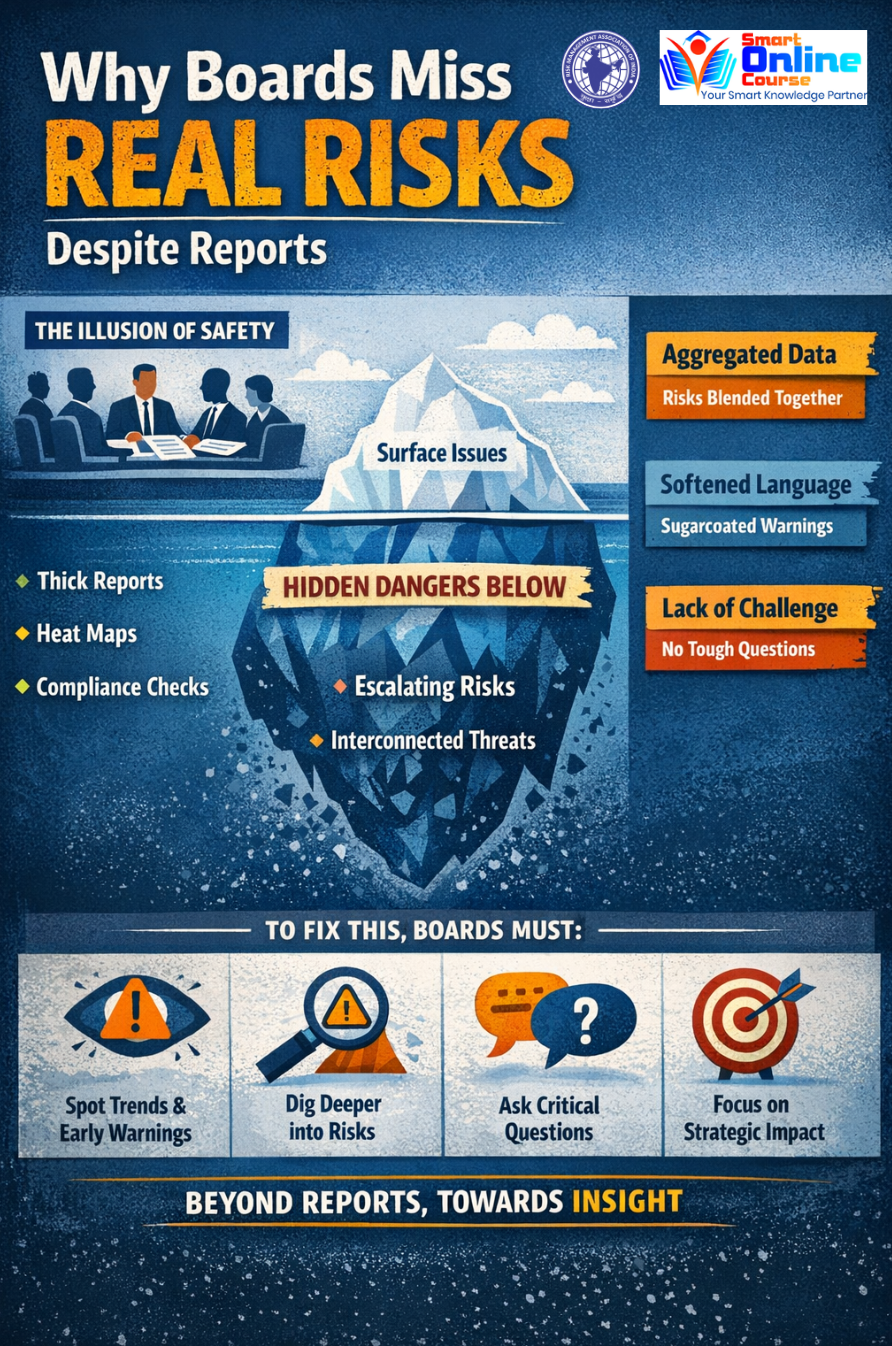
Board reporting often focuses on completeness rather than clarity. Risk reports list dozens of risks, each neatly categorized, color-coded, and scored. While this creates the impression of control, it can also mask underlying vulnerabilities.
When everything is reported as “under management,” genuinely escalating risks blend into routine disclosures. Boards may assume that because risks are documented and reviewed, they are being actively controlled. Over time, reporting becomes a reassurance mechanism rather than a challenge mechanism.
The danger is subtle but serious: boards feel informed, while the organization becomes exposed.
Most board-level risk reports aggregate information. Individual issues are summarized, averaged, or grouped into broad categories. This approach works for stability, but fails during periods of change.
Emerging risks rarely appear dramatic in isolation. They build gradually, across departments and time. When reporting focuses on static snapshots rather than trends, interconnections, and early signals, boards miss how small issues are converging into systemic threats.
By the time the risk is visible at board level, response options are already limited.
Another common issue is the language used in reports. Risks are often described in neutral or reassuring terms. Control weaknesses become “process improvements.” Delays become “temporary challenges.” Exceptions are framed as “manageable.”
This is rarely deliberate deception. It is usually the result of:
Pause and reflect:
If your board relies heavily on heat maps, risk registers, and compliance dashboards, ask a harder question - do these reports reveal how risk is changing, or merely confirm that processes exist?
For risk and compliance leaders, this is where professional judgement matters more than frameworks. Understanding how risks escalate, intersect, and get softened through reporting layers is a skill that must be deliberately developed - not assumed.
This is precisely why advanced risk management learning today focuses on risk interpretation, escalation, and board-level communication, not just methodology.
A powerful real-world example of this failure can be seen in the crisis surrounding Boeing and the 737 MAX aircraft.
Prior to the tragic accidents in 2018 and 2019, Boeing had extensive reporting structures, safety processes, and board oversight mechanisms in place. The board received regular updates on production, performance, and safety matters. On paper, governance frameworks existed.
However, post-crisis investigations revealed a critical gap: the board was not receiving a complete or unfiltered view of safety risks. Technical concerns related to the aircraft’s control systems were discussed within engineering and management layers, but their seriousness was not elevated with the urgency and clarity required at board level.
Safety risks were framed within operational and certification discussions rather than as existential governance issues. Commercial pressures, delivery timelines, and market competition dominated board conversations. As a result, the board lacked a clear understanding of how safety risks, organizational culture, regulatory reliance, and decision incentives were intersecting.
When the crisis unfolded, it became evident that the issue was not absence of reporting, but failure of risk escalation, framing, and challenge. The board had information, but not insight into the true severity and trajectory of the risk.
This pattern is not unique. Boards tend to miss real risks when:
To avoid this trap, risk reporting to boards must evolve beyond templates and traffic-light dashboards. Effective reporting should:
Boards rarely fail because they receive no information. They fail because the information they receive does not reflect reality with enough clarity, urgency, and context.
When risk reporting becomes a formality, boards lose their ability to intervene early. And when early intervention is lost, consequences escalate rapidly - often in ways that could have been prevented.
Strong governance is not about more reports. It is about better conversations, sharper questions, and the courage to confront uncomfortable risks before they become crises.
Recognizing the limitations of traditional risk reporting is only the first step. The real challenge is changing how risk is analyzed, framed, and escalated before it becomes a crisis.
To move from reporting to insight:
At Smart Online Course, in association with RMAI, our risk and compliance programs are designed to help professionals bridge this exact gap between frameworks on paper and real-world decision-making at senior and board levels. If your role involves supporting boards, senior management, or regulators, the next step is not another report - it’s sharper capability.
Explore our Risk Management Course and start building insight-driven governance.