There are no items in your cart
Add More
Add More
| Item Details | Price | ||
|---|---|---|---|

26th January, 2026
Artificial intelligence has transitioned from experimentation to operational deployment. It is now embedded in credit scoring, underwriting, fraud detection, hiring, customer service, and decision support systems across industries. As AI adoption accelerates, so do concerns around bias, model risk, regulatory exposure, and reputational damage.
To address these challenges, the US National Institute of Standards and Technology introduced the NIST AI Risk Management Framework (AI RMF). Unlike purely technical standards, this framework is designed to help organizations manage AI risk at an enterprise level.
For working professionals, understanding the NIST AI RMF is no longer optional. It is becoming a core skill for leaders, risk managers, compliance teams, product owners, and technology professionals.
Also Read: Risk Management Frameworks to Learn in 2026
The NIST AI RMF is a voluntary, flexible framework designed to help organizations identify, assess, manage, and communicate risks associated with AI systems across their lifecycle.
Its primary objective is to promote trustworthy AI, meaning AI systems that are lawful, ethical, robust, secure, and aligned with organizational values.
What makes the framework relevant for professionals is that it is:
More than a technology problem, AI risk is a business risk.
Poorly governed AI can lead to:
Understanding this framework enables professionals to:
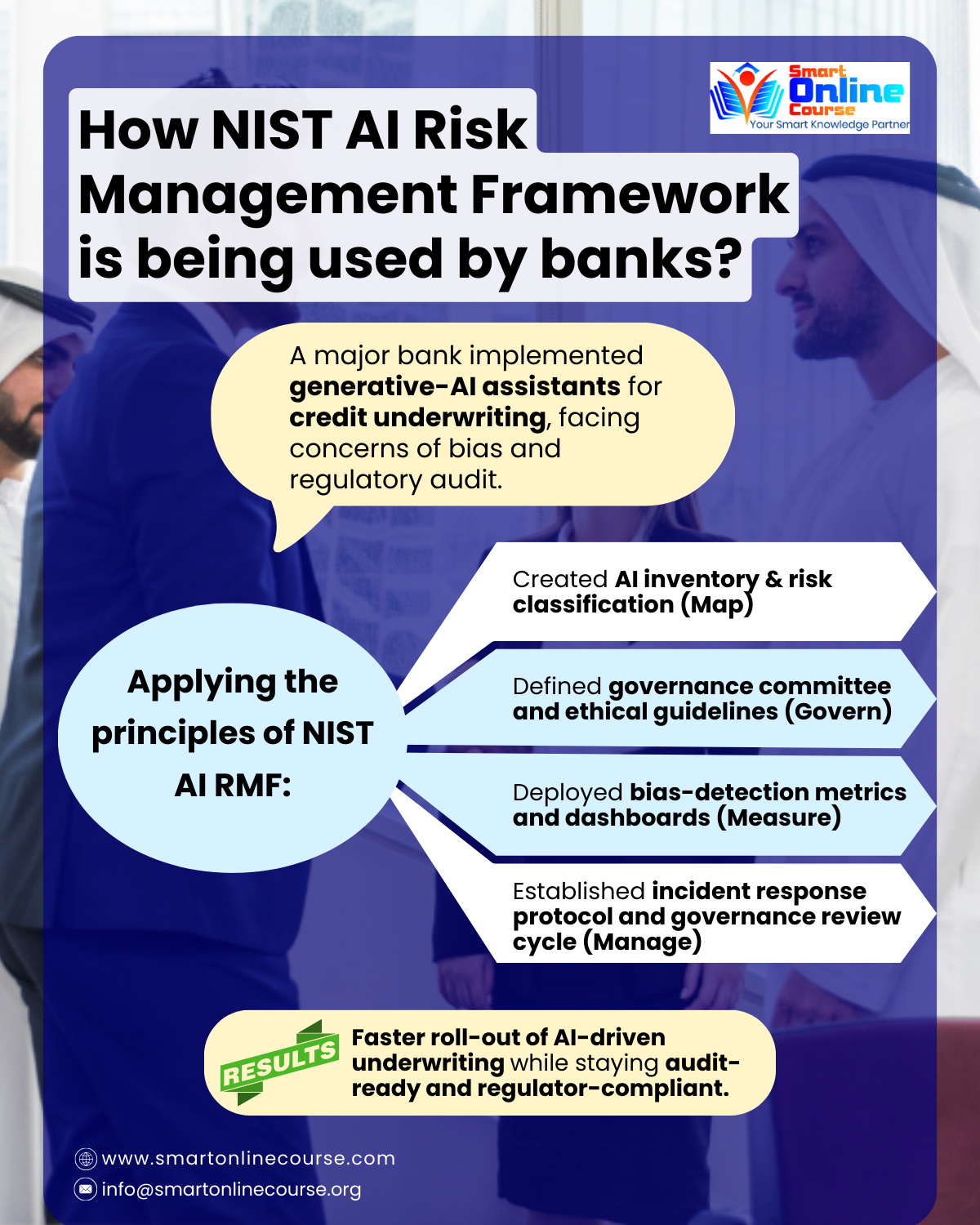
The framework is structured around four core functions that apply across the AI lifecycle.
The Govern function establishes organizational accountability and oversight for AI systems. It focuses on:
The Map function emphasizes understanding context before deploying or scaling AI. It involves:
The Measure function focuses on evaluating and monitoring AI risks. It covers:
The Manage function turns insight into action. It includes:
If you are expected to assess, approve, manage, or oversee AI systems in your role, you need practical frameworks, real-world examples, and regulatory context.
The 9-hour Certificate Course on AI Risk Management by Smart Online Course translates the NIST AI Risk Management Framework into business-ready skills. It is designed specifically for working professionals who need to apply AI governance concepts without becoming data scientists.
While the NIST AI RMF is not a regulation, it aligns closely with emerging global AI governance expectations. It complements:
Also Read: Future Job Roles in 2026: What They Look Like and What Skills They Need
This framework is particularly valuable for:
Understanding the NIST AI Risk Management Framework is the first step. Applying it confidently in real organizational settings is what differentiates professionals.
The 9-hour Certificate Course on AI Risk Management by Smart Online Course, in association with RMAI, is designed to help you:
Enroll Now! Responsible AI Risk Management using the NIST AI Framework