How to Implement ISO 31000: A Step-by-Step Guide

The ISO 31000 risk management standard provides a globally recognised framework that empowers organisations to identify, assess, and treat risks proactively, rather than reactively.

Implementing ISO 31000 goes far beyond simple documentation. It’s about embedding a culture of informed decision-making and accountability across every level of the organisation. Whether you’re in finance, insurance, manufacturing, or public service, adopting ISO 31000 helps you move from risk response to risk intelligence.

Why does ISO 31000 implementation matter?

The ISO 31000 standard provides a versatile, principles-based framework for risk management that is customisable to any organisation, irrespective of size or sector. When implemented well, it helps organisations:

  • Align risk management with strategic objectives and governance.
  • Promote a risk-aware culture where uncertainty and opportunity are explicitly managed.
  • Improve operational resilience, decision-making and stakeholder confidence.

Implementing ISO 31000 risk management: A step-by-step guide

Implementing ISO 31000 means integrating risk management into daily decisions, not just compliance. The steps below outline a practical ISO 31000 implementation process to help you embed risk awareness across your organisation.

Step 1: Define organisational context & governance
  • Identify your internal (culture, capabilities) and external (market, regulatory, stakeholder) contexts.
  • Establish leadership commitment, assign roles and responsibilities, and develop a risk-management policy that states scope, objectives and accountabilities.

Step 2: Conduct gap analysis & framework design

  • Evaluate current risk practices: what you have vs what ISO 31000 expects.
  • Design the framework: set resources, communication channels, documentation, roles and process flows.

Step 3: Identification, analysis & evaluation of the risk process

  • Identify risk events/opportunities across the organisation.
  • Analyse likelihood, impact, complexity and context.
  • Evaluate against criteria and decide which risks need treatment.

Step 4: Risk treatment

  • Develop and implement treatment plans: avoid, mitigate, transfer, accept risks.
  • Assign ownership, carry out controls, integrate with business processes.

Step 5: Monitoring, Review & Reporting

  • Set up performance indicators, monitoring systems and review cycles to ensure the framework remains effective and responsive to change. 
  • Ensure documentation: risk registers, reports, decisions, lessons learned.

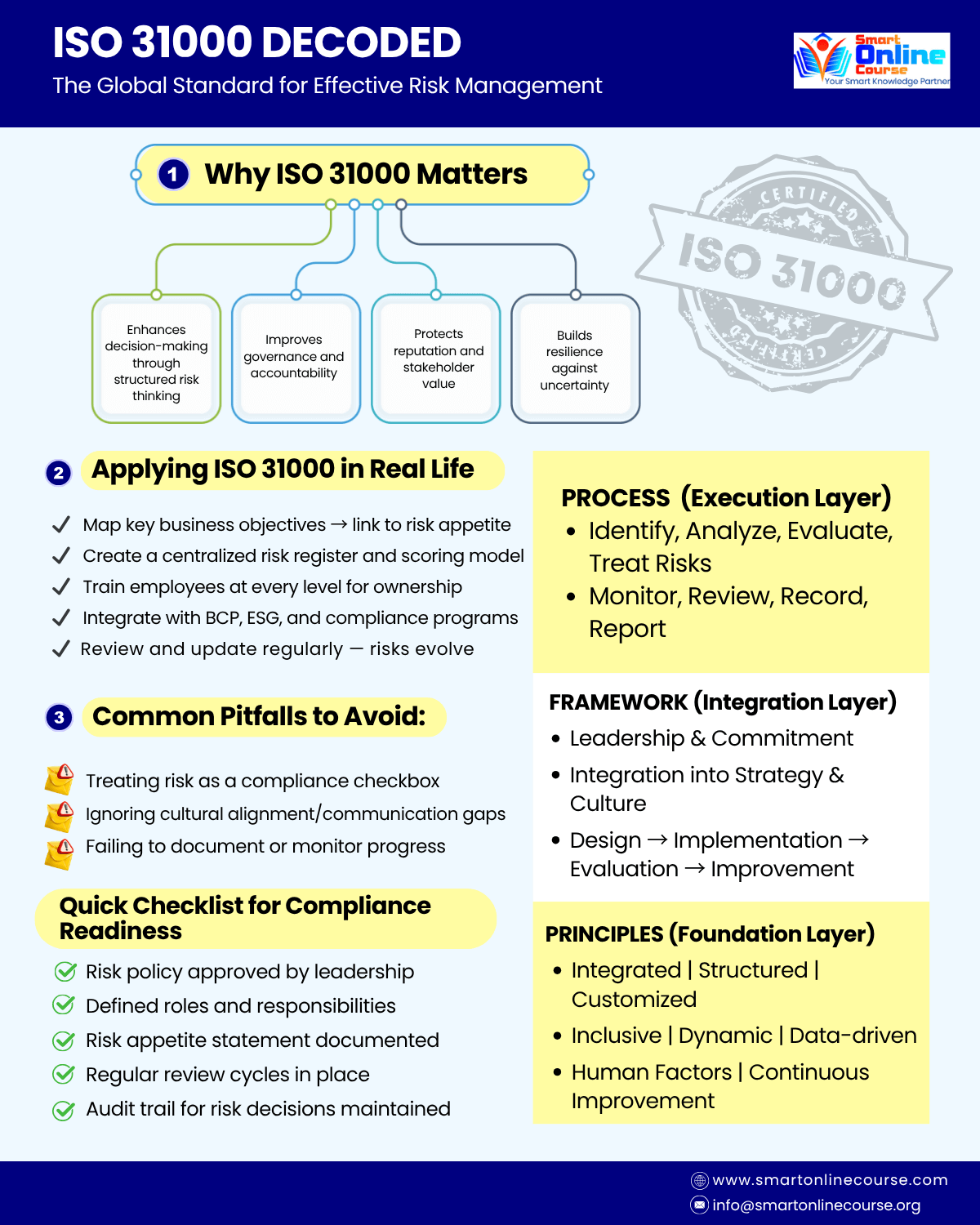
ISO 31000 POSTER

Best practices for effective ISO 31000 implementation

Before you roll out the framework, it’s critical to anchor your effort in the core principles of ISO 31000:

  • Integration: Risk management should be an integral part of governance, strategy, planning, not a standalone activity.
  • Customisation: The framework must be tailored to the internal and external context of the organisation.
  • Inclusiveness and transparency: Stakeholder engagement, clear accountabilities and open communication.
  • Continual improvement: The effort must be ongoing, adaptive and dynamic, not “set and forget”.

Common pitfalls and how to avoid them

Even well-planned frameworks can fail if these issues aren’t addressed early:

  • Over-complex systems: Trying to perfect the framework before starting delays progress - begin simple and evolve.
  • Siloed approach: Risk management must be integrated across functions, not limited to one department.
  • Checklist mindset: ISO 31000 is principle-driven, embed it into culture, not just procedures.
  • Ignoring change: Regularly review and update the framework as internal and external contexts evolve.
To avoid these pitfalls, keep leadership engaged, focus on practicality, and treat ISO 31000 as a continuous improvement journey and not a one-time project. By following the steps above, you move from ad-hoc risk responses to a disciplined, enterprise-wide risk-management approach.
Ready to implement ISO 31000 in your organisation?
SmartOnlineCourse, in association with Risk Management Association of India (RMAI) presents a 4-hour, self-paced online course on ISO 31000, equipping professionals to implement globally recognised risk management principles in real-world contexts.

Enroll Now in ISO 31000 Implementation Course | Certificate Included