There are no items in your cart
Add More
Add More
| Item Details | Price | ||
|---|---|---|---|

Bengaluru, often hailed as India’s “Silicon Valley,” is now emerging as a powerhouse in the Insurtech (insurance technology) space. With a combination of deep tech talent, regulatory openness, and growing consumer demand, the city is rapidly transforming how insurance is distributed, underwritten, and serviced.
This blog explores the key drivers, major players, and future potential of Bengaluru Insurtech.
AI & GenAI for underwriting and claims
Bengaluru’s AI ecosystem is powering tools that improve underwriting accuracy, detect fraud, and automate repetitive processes like document checks and claim validation.
Cloud-Native insurance platforms
Modern insurers and brokers are moving to cloud-based policy administration systems built by Bengaluru tech teams, often replacing decades-old legacy software
Embedded insurance growth
E-commerce, travel, fintech, mobility apps, and device retailers are integrating insurance at the point of sale, which is a model heavily engineered in Bengaluru’s startup corridors.
API-driven distribution
APIs are making it possible for any digital platform to sell insurance, and most leading API insurance infrastructure providers operate development teams in Bengaluru.
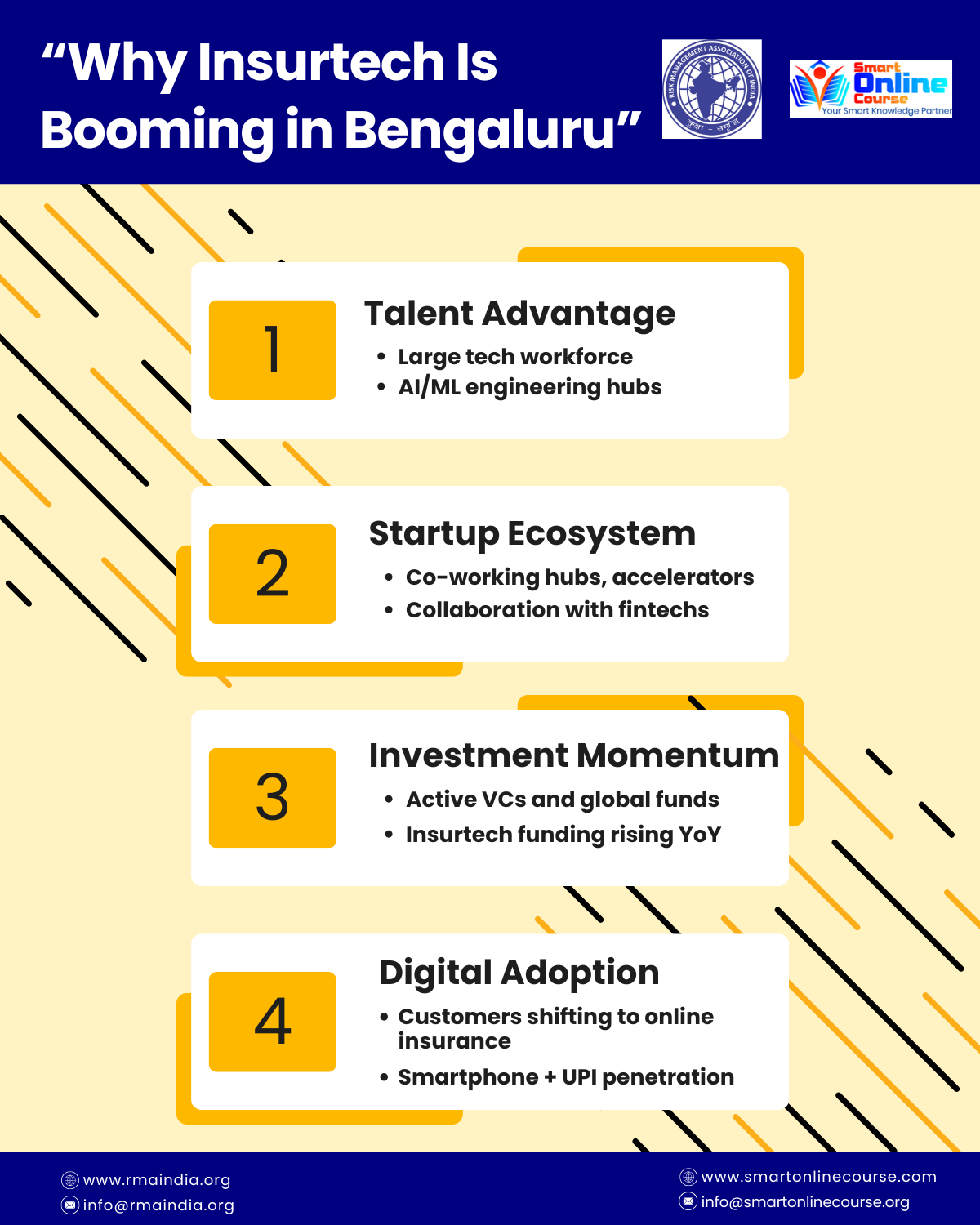
Bengaluru insurtech hub rise isn’t accidental. There are several forces that came together at the right time:
Deep pool of tech talent
Insurance is becoming more about algorithms, data, and automation than paperwork. Bengaluru already had a strong engineering and analytics base, which naturally positioned it to take on insurance modernization.
Startup culture that encourages experimentation
Compared to more traditional financial hubs like Mumbai, Bengaluru has a culture where founders can experiment, fail, iterate, and pivot quickly. This flexibility is vital in a sector like insurance that needs innovation but has heavy compliance layers.
Availability of capital and accelerators
From early-stage funds to corporate venture arms of insurers, Bengaluru has built a network that consistently invests in fintech-insurance solutions. Many global tech companies have expanded their India innovation centers here, which indirectly supports the insurtech pipeline.
Strong base of insurance + tech partnerships
Legacy insurers often look to Bengaluru for collaboration, whether it’s AI-based risk scoring, digital claims automation, or new distribution models. This partnership-driven ecosystem helps startups commercialize faster.
India’s insurtech market has expanded rapidly, but Bengaluru in particular has taken the lead:
Rapid revenue growth
Over the last few years, digital premium distribution, online-first carriers, and API-driven insurance products have gained massive adoption, especially in retail segments like health, motor, and travel.
A surge in digital adoption
For many urban customers, insurance discovery, purchase, claims, and renewals now happen entirely online. Bengaluru’s early digital audience helped insurtechs build and test these models before scaling nationally.
Expansion of B2B insurance technology
Beyond consumer-facing apps, SaaS platforms supporting brokers, insurers, and web aggregators have multiplied in the city. These firms quietly power a large share of India’s insurance operations from the back end.
These companies represent the diversity of innovation coming from Bengaluru:
Acko
A digital-native insurer that operates without physical agents, offering simplified products and frictionless claims.
Go Digit
A Bengaluru-based general insurer that focuses on customer-friendly insurance and tech-enabled underwriting and claims.
Ensuredit
A B2B insurance SaaS platform offering distribution automation, CRM, and broker-support tools that are widely used by insurers and intermediaries.
New-age AI & Data Startups
Several emerging companies in Bengaluru are building solutions around risk modelling, computer vision for claims, fraud analytics, and automated underwriting.
Even with rapid growth, the sector navigates several hurdles:
Complex regulatory environment
Insurtechs must innovate while staying compliant with IRDAI guidelines, which can slow down experimentation.
Funding cycles and consolidation
While the sector has attracted strong interest, funding has become more selective. Startups must prove clear profitability or unique IP to secure growth capital.
Data security and privacy
Handling health, identity, and financial information requires the highest level of security architecture - something many early-stage companies must strengthen.
Scaling beyond India
While Bengaluru startups are expanding into Southeast Asia and the Middle East, adapting to new compliance standards remains a challenge.
Deeper use of AI in pricing and claims
Expect more AI-based risk assessments, automated workshops for motor claims, and real-time fraud monitoring systems.
Rise of micro and parametric insurance
Startups are experimenting with innovative products such as micro-covers and weather-indexed insurance - opening new markets.
Stronger collaboration between insurers and startups
Large insurers are increasingly looking to Bengaluru’s tech ecosystem for partnerships, accelerators, and innovation labs.
Global expansion from Bengaluru
With its engineering talent and maturing playbooks, Bengaluru can evolve into Asia’s largest insurtech R&D hub.
As insurance becomes more data-driven and AI-centric, the city will play an even bigger role in shaping how Indians discover, buy, and experience insurance in the years ahead.
Explore the Banking, Finance, and Insurance Risk Management courses by Smart Online Course in association with Risk Management Association of India to stay up-to-date, and master different aspects of BFSI.
Also Read