There are no items in your cart
Add More
Add More
| Item Details | Price | ||
|---|---|---|---|

June 3, 2026
Credit underwriting is undergoing one of the most significant transformations in its history.
For decades, credit analysts relied on financial statements, ratio analysis, industry reviews, management assessments, and traditional risk models to evaluate borrowers. While these fundamentals remain important, artificial intelligence and Generative AI are changing how credit decisions are supported, analyzed, and monitored.
Banks, NBFCs, FinTechs, and lending institutions are increasingly using AI powered tools to process data faster, identify hidden risk patterns, automate routine analysis, and improve underwriting efficiency.
As a result, the role of the credit risk analyst is evolving.
The future analyst will not be replaced by AI. Instead, they will be expected to work alongside AI systems, interpret AI generated insights, validate outputs, and apply professional judgment where machines cannot.
For professionals involved in lending and credit assessment, developing AI related skills is becoming essential for career growth and long term relevance.
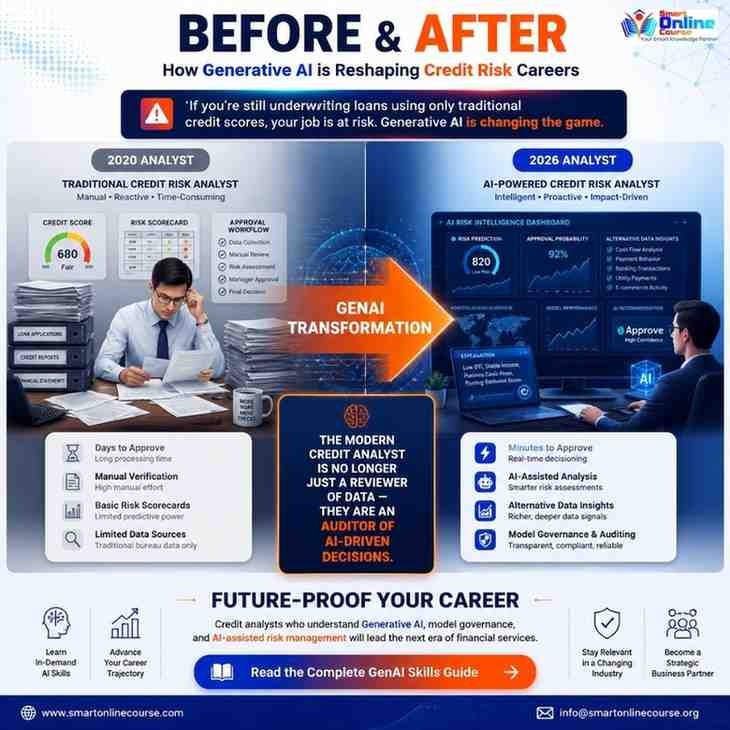
Traditional underwriting processes often involve:
AI enables institutions to:
Generative AI introduces capabilities beyond traditional analytics.
Instead of simply calculating risk metrics, Generative AI can:
However, human oversight remains critical.
Despite rapid advances in AI, underwriting remains a judgment driven function.
AI can identify patterns.
It cannot fully understand:
The analyst of 2026 will combine traditional credit expertise with AI assisted decision support.
The first skill every credit analyst needs is AI literacy.
Professionals should understand:
Modern lending generates enormous amounts of data.
AI systems can process information quickly, but analysts must still interpret results correctly.
Important Capabilities Include
AI models are not perfect.
They can produce:
One of the biggest misconceptions is that AI will eliminate the need for financial analysis.
In reality, financial expertise becomes even more important.
Analysts must continue to evaluate:
Generative AI systems are only as effective as the instructions they receive.
Credit analysts increasingly need to understand how to interact with AI tools effectively.
Practical Applications
Prompt engineering is becoming a practical workplace skill.
AI can identify patterns, but industry expertise remains essential.
Credit professionals must understand:
The future of credit risk management will focus increasingly on continuous monitoring.
AI systems can identify early warning signals such as:
Early intervention often prevents larger credit problems.
As AI automates routine analysis, communication becomes even more important.
Credit professionals must explain:
By 2026, AI applications are expected to expand across:
Credit Origination
While AI offers significant benefits, challenges remain.
Hallucinations
Generative AI may produce inaccurate information.
Data Quality Issues
Poor data can lead to flawed outputs.
Explainability Concerns
Some AI recommendations may be difficult to explain.
Regulatory Expectations
Financial institutions must maintain accountability for lending decisions.
Credit professionals must understand these risks to use AI responsibly.
Professionals who combine credit expertise with AI knowledge will be well positioned for future roles such as:
The credit analyst of 2026 will look very different from the analyst of the past.
Future professionals will combine:
The goal is to use AI effectively while providing the judgment and oversight that technology cannot replicate.
AI and Generative AI are reshaping the future of underwriting and credit risk management.
While technology will automate many routine activities, the need for skilled credit professionals remains strong.
The analysts who succeed in 2026 will be those who understand both traditional credit principles and modern AI capabilities.
By developing AI literacy, strengthening analytical skills, and understanding model governance, professionals can position themselves for the next generation of credit risk careers.
The future belongs to analysts who can combine technology with judgment.
To succeed in the evolving lending environment, professionals need structured learning aligned with modern underwriting practices.
Programs offered by Smart Online Course focus on:
• Credit risk assessment and underwriting
• AI and Generative AI applications in banking
• Financial analysis and risk management
• Digital lending and credit governance frameworksThese programs help professionals build practical capability for future ready credit risk careers.